
Why temporary power gets oversized, and what it costs you
Add up every nameplate rating on a site and you will specify a set roughly twice the size you need. It is a habit, not a calculation, and it has a price.
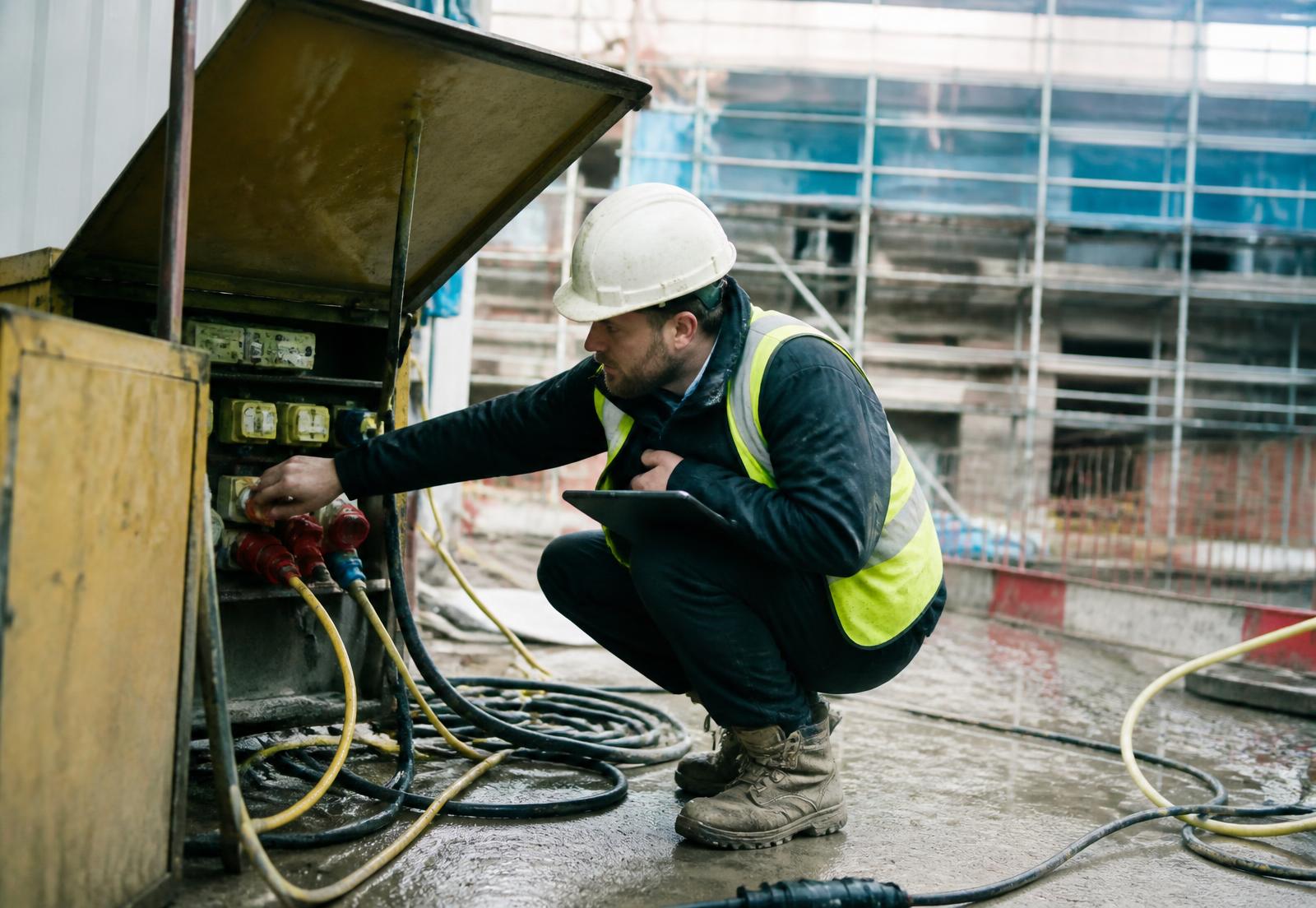
Ask ten people on ten UK sites how the generator was sized and most will describe the same method. Someone listed the cabins, the crane, the hoist, the tower lights and the tool transformers, added up the plates on the side of each one, added a bit for luck, then rang the hire desk and asked for the next size up. Nobody in that chain did anything unreasonable. The result is still wrong.
Nameplate ratings describe what a piece of equipment can draw at its worst moment. They do not describe what it draws on a wet Tuesday in February at half past two. Sum enough worst moments together and you have designed for a scenario that will never happen, because the kettles, the dryers, the crane hoist and the welfare heating do not all reach their peak in the same second.
The cost of a tier you did not need
The hire rate is the visible part, and it is not the worst part. A set running at twenty percent of its rating burns fuel inefficiently, wet stacks, glazes bores and needs more service attention. Over a long hire that lands as call outs, filters and, occasionally, an engine that has to be swapped. It also lands as carbon on a report that somebody has to hand to a principal contractor.
One unnecessary tier carried for a year costs more than the sizing exercise ever will.
Work it through on a typical welfare and crane compound. Take a site whose real peak sits around 90 kVA and whose average through the day is closer to 35 kVA. Specify 200 kVA because that is what the addition said, and you pay a higher weekly rate, you burn more litres per useful kilowatt hour, and you spend the whole programme explaining a fuel bill nobody predicted.
What sizing on behaviour looks like
Sizing on behaviour means asking a different set of questions. Not how many cabins, but what is in them and when do people arrive. Not how big the crane is, but how often it lifts and what its starting current does to the set. Not what the total is, but what the shape of the day is.
- /Apply diversity to loads that genuinely never coincide, and refuse to apply it to loads that always do
- /Size on starting current for motors, hoists and compressors, not running current
- /Keep headroom for the trades that arrive in week six, and record how much you kept
- /Model the overnight base load separately, because that is where fuel quietly disappears
None of this is new engineering. It is the same assessment a competent engineer has always made. The problem has never been the method, it has been the time. Doing it properly with a spreadsheet takes half a day, and half a day is not available when a bid is due on Thursday.
The reason it keeps happening
Oversizing survives because it is defensible. Nobody has ever been hauled into a meeting because the generator was too big. They have been hauled in because it tripped when the crane lifted. Faced with that asymmetry, and with no time to do the sums, everyone reaches for the next tier up. That is a rational response to a bad set of options.
Change the options and the behaviour changes with them. If a defensible, written, assumption by assumption sizing takes minutes rather than half a day, there is no longer a reason to guess. That is the whole argument for putting the calculation somewhere it can be run in the time it takes to answer four questions about a site.
Try it on your next site
Sizr applies this thinking automatically on every job, and prints the assumptions alongside the answer.
Keep reading